How To Read Your Commercial Utility Bill

Your commercial utility bill shouldn’t require an engineering degree to understand, but for many people, that’s exactly how it can feel. Every month, facility managers and operations teams everywhere open a bill that looks more like a dense technical report than a simple invoice.

Pages of rates, riders, demand charges, adjustments, seasonal factors, and acronyms leave even the most experienced professionals asking the same question.

“What are we actually paying for?”

Nearly every organization we work with, from manufacturers and hospitals to retailers and data centers, starts in the same place: trying to decode a document that was not exactly designed with the customer in mind.

The good news is that once you understand how your bill is structured, you gain more control over it. You can spot patterns and anticipate costs rather than reacting to them. And, importantly, you can see where there are real opportunities for resilience and revenue savings.

So, grab a recent bill and let’s walk through it, one section at a time.

Commercial Utility Bill A Breakdown of the Different Parts

Every commercial bill, no matter the utility or state, revolves around a few core components. When you understand those components, the rest of the bill starts to make sense.

Front of the Bill

Your Facility’s Monthly Snapshot

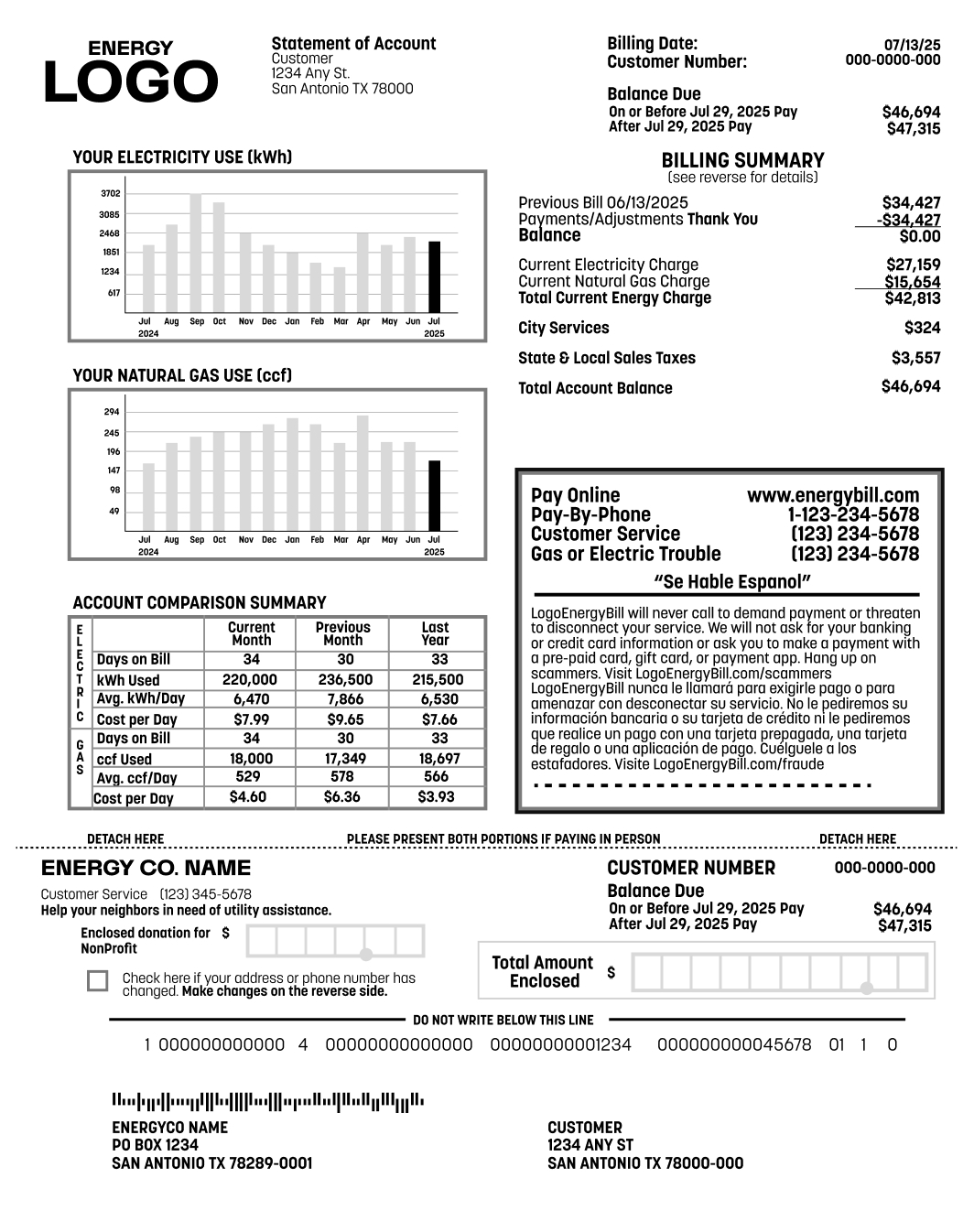
The front, or first page, of your bill typically contains the summary, usage trends, and high-level charges. It’s the big-picture view of how your facility performed over the billing cycle.

front-of-the-bill

Back of the Bill

The Details Behind Your Charges

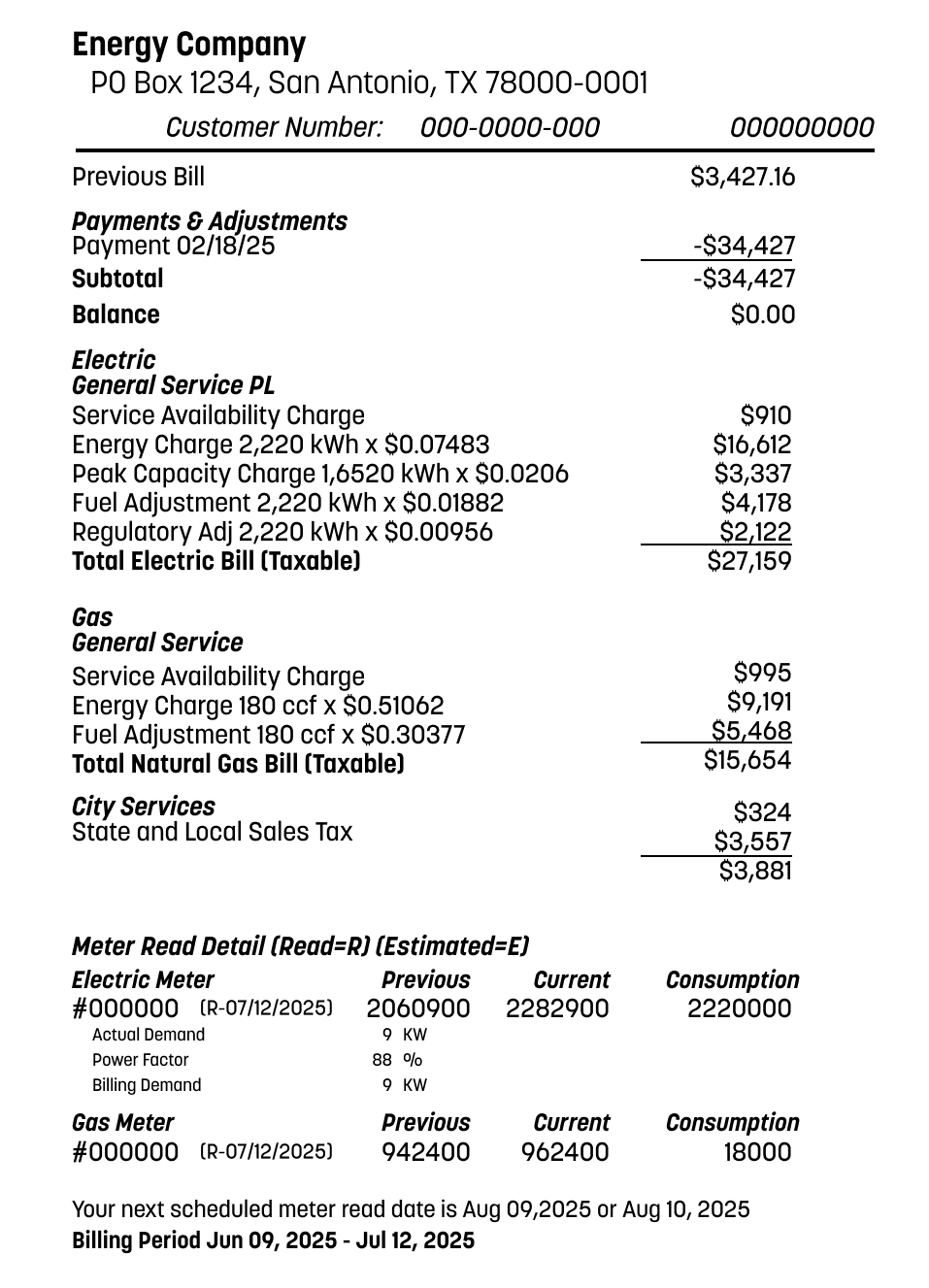
The back of the bill, or second page, is where the utility breaks down how it calculated your charges.

back-of-the-bill

What’s Behind the Total Due

Every line item on your bill contributes to the final amount you pay. These are some of the most important concepts to understand.

Delivery Charges (T&D):

The Cost of Getting Power to You

Even if you buy your power from a really competitive supplier, your local utility still delivers it over the poles, wires, transformers, and substations they maintain.

Delivery costs usually track to peak demand (kW) rather than total consumption (kWh). That means one sudden load can raise these fees for the whole month.

These costs might include:
  • Distribution charges for maintaining local infrastructure
  • Transmission charges for moving power across long distances
  • System reliability riders
  • Storm recovery fees
  • Meter service charges
  • Grid modernization fees or state-required adjustments
Why this section matters:

This is where you can feel the impact of your facility’s highest-power moments, even if they lasted only minutes.

markets

In deregulated markets, you might see this section on a separate bill entirely, coming from your contracted supplier. In regulated markets, it appears right alongside delivery charges.

Many customers focus almost entirely on this number, because it feels familiar: rate × usage. But in commercial billing, supply charges often play second fiddle to demand-driven costs.

Supply Charges (kWh):

The Electricity You Actually Used

If delivery is about how power reaches you, supply is about how much you consume.

This portion is usually more straightforward:
  • Energy rate ($/kWh)
  • Total kWh used during the billing cycle
  • Fuel cost adjustments
  • Generation fees
Why this section matters:
This section reflects operational trends, but it is rarely the biggest opportunity for savings.

Demand Charges (kW):

The Hidden Driver of Most Commercial Bills

If there’s one line item to understand, it’s this one.

Demand (kW) represents the highest amount of power your facility pulled during a short window, usually 15 or 30 minutes. It’s your peak moment of the month.

Demand charges exist because utilities must keep enough capacity available for your peak, even if it occurs only once.

Examples of events that trigger high demand:
  • All HVAC units restarting after a weekend away
  • A production line powering up simultaneously
  • Cold storage compressors ramping after defrost cycles
  • EV fast chargers pulling large loads
  • A chiller or industrial pump kicking on unexpectedly
Why this section matters:

Demand charges can account for 30 to 70 percent of the total charges on a monthly electric bill, according to Clean Energy Group. That’s why it’s often one of the most powerful cost controls for commercial customers.

Power Factor:

The Efficiency of Your Power Use

Power factor describes how effectively your equipment converts electric power into useful work.

A perfect power factor is 1.0, meaning everything you draw is being used efficiently.

When your power factor drops, utilities may add surcharges because low power factor strains both the grid, in addition to the toll on your own equipment.

If your bill includes these charges, it’s usually a sign of deeper power-quality issues and not just consumption.

But many commercial facilities sit around 0.8-0.9, especially if they use:
  • Motors
  • Variable frequency drives (VFDs)
  • Refrigeration systems
  • Welders
  • Medical imaging equipment
  • Pumps or compressors
Why this section matters:
Power factor issues often correlate with increased equipment wear, more frequent resets, and higher operating costs.
us-state

These charges vary widely by state and utility. And while these charges may look small individually, they often scale with kWh or kW, meaning better energy management still reduces them indirectly.

Taxes, Riders & Regulatory Adjustments:

The Fine-Print Charges

Every utility and state handles this section differently, but it often includes:
  • Utility taxes
  • Renewable portfolio riders
  • Environmental compliance charges
  • Local franchise fees
  • Deferred fuel adjustments
  • Transmission congestion charges
Why this section matters:
You can’t eliminate these fees, but you can influence how much they apply to.

Putting It All Together
The Real Story Your Utility Bill Is Telling

Once you break the bill into these sections, a few themes become clear.
profit-analysis
Your peak moments often matter more than your total usage
equipment-behavior
Your equipment behavior affects charges you might not realize exist
power-quality
Your vulnerability to power-quality issues shows up in the form of penalties and maintenance costs
bill
Your bill reflects how dependent your operation is on the grid and how exposed you are to its fluctuations

This is exactly why e2Companies built Virtual Utility®: to give businesses tools that directly influence these charges. Not just to understand them, but to reshape them.

How e2Companies Helps You Take Control of Your Utility Costs

Lowering energy usage will only get you so far with managing your costs. You also have to control the factors that make commercial bills unpredictable: peak demand, power quality issues, and dependence on an increasingly stressed grid.

At e2Companies, we spend every day helping customers overcome these challenges. Through Virtual Utility®, the R3Di® System, and the Grove365 monitoring platform, we take the guesswork out of energy decisions and replace surprise charges with predictable, reliable power.

lowering-energy-usage

Brings utility-grade power directly to your facility, combining on-site generation, energy storage, and grid optimization so you stay resilient and cost-efficient regardless of grid conditions.

A patented power generation and LiFePO4 storage system that operates in sync with or independent from the grid. Reduce peaks, improve power quality, and ensure uninterrupted operation.

A real-time operational hub that monitors your assets and optimizes energy use.

What This Means for Your Monthly Bill

Take control of your facility’s energy behavior, and the results become apparent on every monthly statement by helping you:
mdi_check-outline
Reduce peak demand
mdi_check-outline
Avoid price spikes
mdi_check-outline
Eliminate voltage-related penalties
mdi_check-outline
Improve power factor
mdi_check-outline
Lessen dependency on unstable grid periods
mdi_check-outline
Lower emissions
mdi_check-outline
Unlock new revenue opportunities
mdi_check-outline
Gain predictable, stable energy costs over time
As a whole, that means you can stop being a passive energy customer and become an active energy manager, without having to change how your facility operates.

Take Control of Your Energy Bill

A quick conversation with our team can reveal how much control you can gain over reliability, demand, and monthly spend across your facilities.