Why Hospitals Need A Better Power Solution

Backup diesel generators and UPS systems have powered hospital emergency protocols for decades.

But as the grid grows less reliable and storms grow more severe, the gaps in that model are growing harder to ignore.

Aging generators are more prone to failure.

87% of hospital generators in an 80-facility LA County study were more than 30 years old — and some were older than 60.1 Aging generators require extensive maintenance to remain reliable, and facilities that defer that maintenance face significant risk when the grid fails.

calendar icon
87% of generators are 30+ years old.

UPS systems aren’t fail-proof.

40% of diesel generator outages in the Uptime Institute's 2023 analysis were caused by UPS system failures — the systems designed to bridge the gap.2

failure
40% of outages linked to UPS failures.

Backup systems only power critical loads.

Diesel generators and traditional UPS systems are sized to carry loads for lifesaving equipment, not the entire facility. During an outage, patients can wait in the dark for hours without heat, air conditioning, or non-critical lighting.

off
Non-critical areas can go dark during outages.

Generators weren’t designed for long-term outages.

Joint Commission standards require hospitals to plan for 96 hours of outages. Catastrophic storms routinely exceed that window.

storm
Major storms often exceed backup duration.

Generators take up valuable hospital real estate.

A single generator can take up an average of 4,000 square feet, and large hospitals need 3-4 units. That takes away from space that could be used for new equipment and patient care.

large
Large hospitals need 3–4 units.

Diesel generators create real environmental and regulatory risk

Diesel generators emit carbon dioxide, nitrogen oxides, and sulfur oxides. As emissions regulations tighten, hospitals relying on legacy diesel face growing compliance exposure — and a shrinking window in which they can legally operate during a prolonged grid event.

time

The U.S. EPA limits diesel generator run time to 100 hours at full load per year.

Explore
Explore
CHAPTERS
Download the Accelerating Grid Modernization PDF Today!

Virtual Utility®:
Scalable, Sustainable
On-Site Power

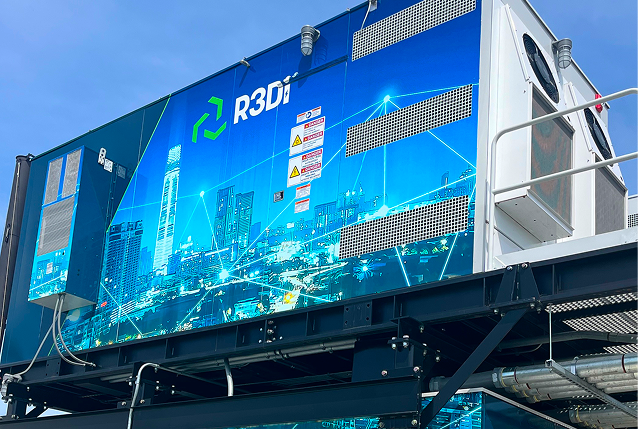
e2Companies' R3Di® System and Virtual Utility® deliver conditioned, uninterruptible power to every load in your facility — not just critical systems — while enabling real cost control through demand response.

The R3Di® System carries UL 1778 certification for UPS systems, a critical compliance factor for healthcare facilities. It’s rated to run prime, so your facility stays online whether a storm lasts four days or four weeks.


circle-animate
Diesel + UPS
Response time
Instant
20 seconds or more for full building load
Load pickup
Full
Critical only
Runtime
Continuous 8760 hours/year
50 hours/year for the diesel generator (per US EPA limit)
Controls variable current, voltage + frequency from grid
Yes
No
Requires utility interconnection agreement
No
Yes
Battery lifespan (most common chemistry)
Lithium iron phosphate - rated for 6,000 cycles
Lead acid - rated for 1,500 cycles
Power efficiency
99% at full load
40% at 80% total load capacity*
Carbon footprint
Reduced by 90% compared to diesel generators
Increased regulatory controls
Space requirements
Significantly less than diesel generators
Could be up to 50% of building space and 20-40% of land
Designed to integrate with renewable sources
Yes
No
Continuously monitored by software
Yes
No
Enables participation in utility incentives 
Yes
No
Tax credits available
Yes - up to 40% via the Federal Tax Incentives Bill
No

Ready to rethink how your hospital is powered?

With the grid becoming less reliable and aging diesel generators prone to failure, it’s time for a more proactive approach to powering hospitals. Schedule a consultation with us to see how Virtual Utility® delivers uninterruptible, full-facility power with a lower total cost of ownership than diesel.

virtual_utility_logo
Frame 3-4