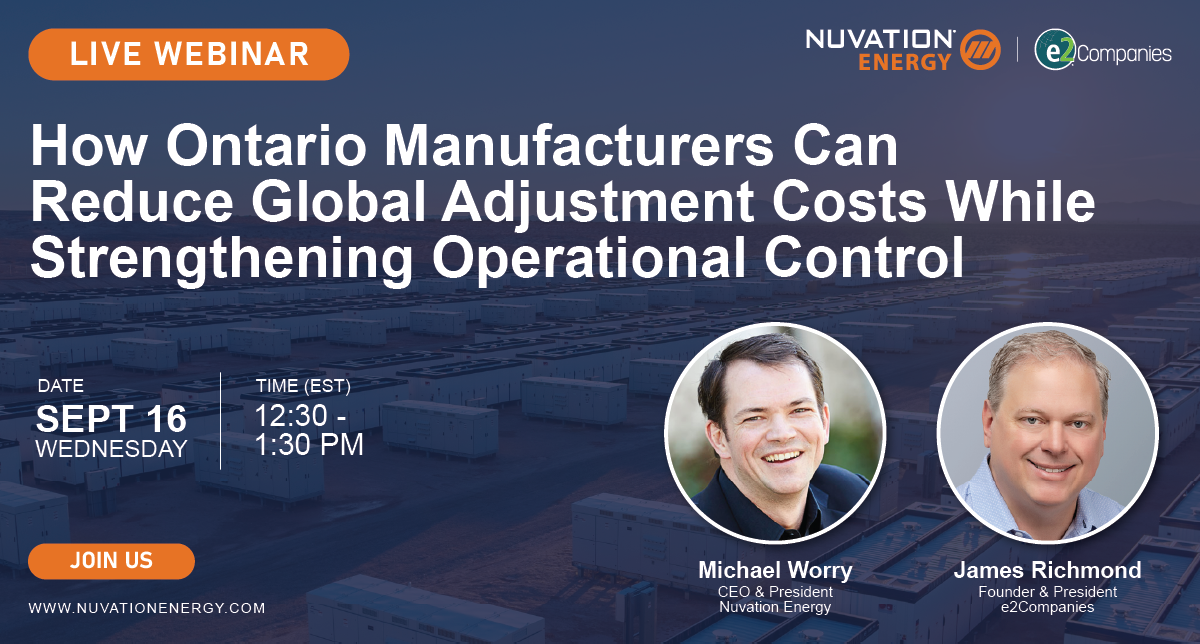
Greetings, everybody. I'm, uh, Michael Wherry from NuVation Energy, and, uh, today we're gonna be speaking about how Ontario manufacturers can reduce global, uh, adjustment costs while at the same time strengthening operational control. Um, by way of introduction, I'm, uh, CEO and, CTO of, uh, NuVation Energy, and, uh, and I'm, joined here by, uh, James Richmond, my good friend from E2 Companies.
Thanks for having me, Michael.
Yeah, absolutely. Great to share a stage with you again. You and I have, uh, done a few of, these, uh, various, uh, webinars and, so forth.
Um, so, uh, before we get started, just a couple, uh, housekeeping comments. Um, so we are gonna be recording this session, um, that does allow us to share, uh, the recording afterwards. Uh, so everyone here will get a copy, uh, of, of the slides and a link to the recording that was taken. Um, uh, we encourage, uh, Q&A, uh, to be done throughout, uh, the session, so you can submit your questions using the
Q&A feature. Some questions we may splice in the slides, uh, while we're speaking if it's relevant to the slide we're on. Um, otherwise, uh, we'll, uh, catch 'em up at the end. We've got, uh, time set aside for
Q&A at the end.
Um, and, uh, and then because this is like a webinar format, uh, we've got the attendee microphones, cameras and chat, um, those are turned off.
Next slide. Um, so I'll start off with talking about, uh, NuVation Energy and, uh, introducing who we are. Um, so this is very much, uh, a webinar for Ontario companies. We're specifically talking about, uh, global adjustment and, uh, and so NuVation is a fellow Ontario company.
Uh, I'm born and raised, uh, in King City, went to high school in Aurora, and then got my electrical engineering degree with the Iron Ring from University of Waterloo.
Um, I' founded, uh, NuVation back in 1997, um, in Waterloo. That's our office over on Bathurst Street.
Um, and so we're coming up on, uh, being in business for, uh, thirty years. Uh, we've got, uh, over sixty employees. Uh, indeed, our headquarters is in
Waterloo. Uh, we do, uh, the majority of our engineering in Waterloo, and, uh, and we do our manufacturing in Markham. Um, so we're fully, uh, Canadian owned and operated. Um, and, uh, all of our product development and, uh, uh, manufacturing are performed within
Canada. And so this is all of our hardware design, software design, everything like that. So inside of our products, um, all of our, uh, schematics and all of our code, um, is our own designed and, uh, developed in-house in Canada. Uh, and we have, some employees, uh, in the
US.
Next slide. Uh, so NuVation works in two main categories. Um, so overall, we provide products and services to companies who design and deliver energy storage systems.
Uh, our primary product is, uh, battery management systems.
And, uh, on the screen there is our fifth generation battery management system.
Um, goes up to fifteen hundred volts DC, which is what is most commonly used, uh, inside of, uh, US, Canada, UL nineteen seventy-three designations. Um, our BMS is recognized under UL nineteen seventy-three, which is the most common, uh, functional safety designation. Uh, we have a lot of cool, differentiated advanced capabilities, um, uh, such as continuous balancing and so forth.
Um, this webinar is not so much about our BMS as a component within the technology stack of the overall energy storage system. Um, but certainly happy to, to dive in if there's any questions in the direction of, uh, how our BMS operates.
Um, the other piece that we offer is energy storage design services. And, uh, and so we're, for example, doing that with E2, um, designing, uh, the next generation systems.
And, uh, this is when customers hire us, in order to design energy storage systems to their requirements. And, uh, and the customer owns the resulting intellectual property that comes from that.
And we can do everything up to the level of containerized, uh, energy storage systems.
Um, and so this includes, uh, everything around that. So designing battery modules, uh, stacks, uh, containers. Uh, we can help select, uh, battery cells, uh, PCs, everything around that. Next slide.
These are some of the highlights, uh, of NuVation. As mentioned, uh, fully Canadian, uh, designed and manufactured.
Uh, we've had product in the field for over, uh, fifteen years. Uh, we've been doing this a long time. Um, we have, uh, security built in at multiple layers, uh, inside of our products.
Uh, and then we actually have authentication chips that communicate between our products, uh, to make sure that, uh, everything is bonafide, uh, NuVation battery management systems. Uh, we've been doing this a long time. We've got gigawatt hours of BMS deployed in the field.
Uh, so we have data on, uh, on our field failures. Incredibly low, uh, very low, uh, field failures, um, single digits and millions. Um, we have a whole care team, uh, which provides support to our customers, uh, making sure that, uh, our, our systems are running well, and we manage all configuration files and things like that. Um, from the beginning, uh, our products have always been, uh, designed with a mission-critical, uh, perspective. Um, so our products, uh, have, uh, these robust diagnostics, uh, watch died timers, uh, ability to remotely upgrade it with authenticated, uh, connections, uh, and all the things you'd look for in a battery management system. Uh, a lot of our customers are lithium-based, uh, most commonly LFP, uh, but our BMS is highly configurable, and so it works across a wide range of different chemistries.
Um, so it can also be lead-acid, uh, zinc, uh, sodium, uh, wide variety of different chemistries. Uh, and then our manufacturing lines, uh, we own all of our own manufacturing test equipment, and, uh, we've got enterprise-grade controls around that. So we have our own in-house developed systems in order to keep track of, uh, all of that.
Next slide All right, so let's dive into global adjustment.
And, uh, so, uh, this webinar got kicked off because I was speaking with a variety of, uh, Ontario executives and, uh, and, and a common complaint was, you know, I get my electric bill, and it's like, "Wow, how could my bill possibly be this high?" Um, and the challenge is that, uh, global adjustment is hard to budget for and hard to predict for, um, because what the, uh, Ontario government does is they splice up their costs, um, and then, uh, pass that out, um, to the customers.
And this can be, uh, therefore difficult to predict, um, and also a bit frustrating, um, that it's, uh, it's kind of outside of our control in order to control Ontario's total system costs.
However, what you can control is control your exposure within that, and then we're gonna be presenting some options as to how to do that.
Next slide. Um, so what happens when we have these global adjustment issues? So, uh, h-how it's done as Ontario is it's the top peak five hours, uh, so not even the top five days, the top peak five hours, uh, and that determines, um, how much of, uh, global adjustment costs are passed back to you, uh, especially for Class A customers. We'll get into defining that.
So what do you do? Um, you know, if you, if you know you're up against a peak hour, do you just shut down a production line, send people home, um, you know, try and reduce your costs?
Uh, well, that's not a great way to run a business.
Um, and so there are these conflicting priorities of how do I keep production running, um, while also controlling my global adjustment costs? And that's the solutions we're gonna be presenting today, um, around the, the REDI system and, and what's available there.
Next slide. So, uh, once you start talking in conversation of siting, uh, energy resources directly, um, at the site, uh, it gives you the ability to get a number of advantages. Um, so the first and the key one we're talking about today is reducing your global adjustment exposure. Um, so eligible Class A customers can lower their peak demand factor, um, by reducing their consumption by using on-site energy generation, uh, or on-site energy storage, and doing that specifically during Ontario's five highest demand hours.
Um, the other advantage is protecting, uh, production continuity.
And so by having on-site energy resources, uh, you achieve this virtual utility, uh, perspective, um, where you are your own utility and, uh, you can support, uh, your full facility load, um, even if there's grid events. So there's, uh, you know, voltage brownouts, uh, frequency regulation problems, um, glitches, uh, in supply.
Um, with, uh, with the REDI system, uh, all of that is protected.
Um, the next is you can actually access demand response revenue. And so once you've fulfilled your needs on site, uh, for, for resiliency, um, then with the, uh, energy generation, energy storage, uh, equipment that's available, um, you can actually compete to provide capacity through Ontario's electricity market.
So, uh, inside of all this, and we can support you in figuring this out, um, the rate strategy is a combination o-of, of your factory's, uh, electricity profile, whether you're a Class A status or not, um, your operational requirements, and, uh, and what on-site energy resources are there. Next slide.
So global adjustment. So a-as mentioned, uh, global adjustment is there to cover the difference between electricity market revenues, um, and the amounts that are paid out, the expenses that come with it.
Um, and, uh, how that is handled, uh, is different between Class A and Class
B customers. So Class A customers, these are your larger customers, uh, and they pay a share, of, the province's total global adjustment based on their electricity use during Ontario's five highest demand hours.
And, and part of the challenge we'll talk about in the next slide is we don't know when those hours are gonna be. Um, Class
B customers, um, they, uh, uh, they're not specifically tied to the peaks. Uh, they pay their global adjustment based on their total electricity consumption, um, each month and, uh, the applicable, uh, Class B rate. Um, so for a Class
A, uh, manufacturer, um, when electricity is drawn from the grid can really matter as much in your total electricity costs as actually how much electricity is consumed.
Next slide.
So, um, it sounds like there's some advantages in being a, a Class A, uh, category.
Um, h-how do we qualify for Class A? So this is broken down into three groups. Um, so the first group is more than five hundred kilowatts and less than one megawatt. Uh, this is for, uh, certain manufacturing, industrial, and greenhouse facilities.
Um, the next group is more than, uh, one megawatt and up to five megawatts, and in that category you can opt into, uh, the Industrial, uh, Conservation Initiative, um, but you must opt in in order to receive the, the Class A treatment.
Uh, and then the third category, if you're up over, uh, five megawatts, um, then you're automatically eligible, uh, to participate in the ICI, uh, and you actually have to opt out, um, if you do not want, uh,
Class A treatment.
Um, and so eligible facilities are notified, um, but, uh, eligibility does not automatically mean Class A is the best financial option.
So we can work with you to look at these different categories, see where your, uh, facility is, and see what makes sense. Next slide.
So this is how manufacturers manage, uh, potential peaks around that.
Um, so the, uh, five peaks are confirmed after, uh, the base period, and so the result of that is, uh, you have to respond on more than, uh, five days 'cause you don't know, uh, until year-end, uh, where those specific five peak hours were. Um, so the first is you gotta monitor, uh, for potential peaks. So this is looking at, uh, like
Ontario, uh, demand forecasts, um, weather conditions. Uh, we're gonna look at, uh, facility data of, like how the factory's being used, um, what loads are there, uh, and we're gonna look for peak alerts, uh, to identify hours that may become, uh, one of the province's five highest demand periods. So this is the first step, just monitoring.
Second is establishing a response plan, so what are we gonna do about that? If, if we think we're coming up on a, on a peak hour, what do we do?
Um, so, uh, are certain loads left operational? Um, a- are certain, uh, critical loads kept there and other loads, uh, tacked offline? What's the response?
Um,
I'll, I'll, I'll, I'll, I'll give a little bit of the solution that James will be talking about.
This is all very complicated stuff, but, uh, because we have automated global adjustment algorithms, you know, with... this stuff is handled for you. Um, third is reduced grid demand. And so depending on the facility, uh, there may be, um, some loads that are deferrable.
Um, and, uh, and some, you know, factory lines provide the ability to do that. Um, but even better is to put on-site energy resources, um, that can provide for, um, all of your needs and, uh, you know, we can focus on handling the global adjustment for you, and you guys can focus on running your factory. Uh, and the fourth i- is then to verify performance, and so the other side of this, you know, measure the facility's grid consumption, um, during that response and, uh, and use those results in order to continue to refine, uh, future peak management decisions. Yeah. Michael, we have a timely question here from the audience- Oh, great ... up here.
So, uh, so to jump in here, the question is, "Do I have to slow down or curtail my production, uh, when a potential peak is identified?" Yeah, great question. And historically that's been how this isn't handled, um, is that, uh, historically the only way to, uh, reduce your energy usage, um, is when you think you're coming up on that peak, to actually try and offset your loads. What we're talking about today though is an even better solution, uh, where you can site a, a REDE system on site. Uh, it's a combination of, uh, energy generation and energy storage. Um, and then you can just continue to, to run your factory however is best to run your factory.
Um, in Innovation 82, uh, we can manage, um, that electricity usage and be your virtual utility for you.
Great. Thank you.
All right. I think I've covered this slide. Next slide. I think that hands it over to James. Great. Thanks, Michael.
Uh, I'm James Richmond, the CEO of E2 Companies. And, uh, just to give you a little bit of history and background on us, we actually started in 2009.
Uh, we've been in the distributed generation space since we started. We started, uh, by adding emission systems to old diesel engines in the marketplace, cleaning those up, and have, uh, transitioned all the way to the battery energy storage system space and, and UPS space, uh, as a product. So in the years of doing that, we, we've done over about, uh, a little over 1,000 installations.
Um, but what we really had made a difference as a company is we set out, with electronic monitoring tools. So my previous company, we did a lot of IoT work, which used to be called the Internet of Things.
Um, and in that space, you know, the idea was,
"How do you look at things and see what they're doing and monitor that activity to give you insight of how to make change?"
Well, the nice part about that is, is AI has come along in the last few years, and the more of that history that you have, the better your AI models become.
So because of our history of monitoring grid conditions and emissions and things of that nature, that number becomes a very important number for our ability to do these predictive analytics.
So when you take now, you know, we, we've got a little over 1,200 megawatts that we have running in the market. Some of those are in the Ontario market as well.
We were putting assets in Ontario now since probably
2017. So, you know, prior to COVID, it was a very, uh, lucrative process. People were doing it a lot. There was a couple of years of hiccups during COVID, which kinda slowed the process down. But now that we've normalized from the COVID timeframe, everybody's back to, "Oh my gosh, these GA bills are out of control."
So that's a little bit of the history of, of what we've done there.
Uh, and we to date have managed about $2 billion in energy market savings, uh, across, uh, a number of customers in North America.
So next slide. So effectively, we call ourselves a, a virtual utility, uh, for your facility. And when you think about what we do, we're providing you everything the utility can do behind the meter, which gives you what we call energy sovereignty.
So effectively, you can run your facility the same as on, grid, but off grid.
Typically, there's a little bit of a premium to do that.
Uh, but when you combine the two together of taking the value of GA, this system behind the meter, you're giving yourself resiliency, reliability, economics, and emissions advantages. So you're g- bringing all that into play here. Uh, we can bring in your renewables if you would like, whether it's wind, solar, uh, or PV as some people call it , uh, fuel cells, anything you want behind the meter besides, you know, diesel or natural gas engines, turbines. All that comes into a platform that becomes very plug and play, uh, with our system.
Next slide. So the, the featured product that we've been doing with Michael now for probably some seven or eight years, uh, we call the REDE, uh, which is, y- you know, the system that we started in really response to grid connections.
So this product was really developed because we were doing work with large utilities-
And you've probably heard, or maybe you haven't, there's an interconnection problem that comes in with hooking with utilities, and there's a long term and a long line to get into engineering studies. So when you start getting an engineering study to deploy these assets, you're really adding lead time before you can get things installed.
So some of those lead times, uh, in North America, believe it or not, are three to seven years, uh, before you can get a utility approval to actually deploy assets to be in this marketplace.
So the, the concept behind our system is really to increase that deployability in under 12 months.
So the objective for us is how do we get you power out there quick, uh, and then the unit's instant power delivery capabilities.
So unlike a normal BESS, which would have what we call a parallel interconnect, and, and just not to complicate this too much, uh, what that means is, is you're actually having to do what the utility does at all times. Our system, as being a microgrid, allows us to always be forming your own grid on your customer property.
So that gives you huge advantages that you're disconnected from the utility, and you're only extracting the power that you want at the price you want to extract it at.
So that's really about, you know, this any energy source. We can use the utility, we can use backup generation, fuel cells. You name it, we can use it. So some of the pieces that help us do this for your facility in a much more compact footprint is this, what we call high C power rate, uh, or a power battery function. And what that does is it really allows us to not have to oversize generation. So, uh, if you have what we all know is called inrush current, so when you turn something on, there's a spike, and then it kinda levels off, like your air conditioners, things of that nature. It's a very small period of time. But those spikes, when you take those out with a power battery, allows you to size the power at a more average load as opposed to these peak loads.
So when you can get rid of those spikes, and you do that very fast, you see no blips in your facility.
Nothing happens. This is two inverters, so it is dual inversion,
Mitch-- conversion, which means we are actually acting like a UPS. It is UL-rated like a UPS as well. So it's both a nine five forty battery energy storage system and a UL seventeen seventy-eight UPS.
So we're actually bringing both of those to your facility, which lowers maintenance costs, cleaner power. You don't have any of the blips, the flickers, all those things that go on when you're on the grid. All that gets eliminated as a side benefit through this system. So go ahead to the next slide. So from a graphical standpoint, this is what it looks like from our system.
Um, on the left is a traditional backup system that you would buy from
Caterpillar, Cummins, you name it, anyone who supplies you a generator.
So on that generator, when you lose utility, you have this loss. It lasts, you know, typically you try and get it in under ten seconds.
Some people are longer depending on their size.
And then when that generator kicks up, you can see this kind of bobbling that happens at the top, which is, is what we call the level icing of power form, right? So you have this blip, and then it kind of smooths out for you. Well, that's very hard on your equipment.
And then when you go back to the utility, the same process happens in reverse.
So you lose power again, and then you go back on the utility, and the utility kind of does the same thing to you, just not quite as bad. So if you look on the right, you see what happens. This is the same low signal. So this is on the utility side, and this is on the E2 virtual utility ready side.
So this is the same input inverter versus output inverter and what your facility sees.
So when you look at the right side of this graph, what you see is a nice flat line, and that's all your facility ever sees. You don't even know anything happens unless you were outside and heard the switch gear and things clicking.
Uh, that's effectively what we do. We had this third party vali- validated with HDR, who's a very large, uh, data center mission-critical engineering firm. And we did this, um, six years ago now. So this is not a new development for us.
Uh, we're actually on our third generation of product that Michael had mentioned earlier his firm is helping us design.
Uh, and we're just going bigger in size now with effectively the same, uh, technology plan. Next slide.
So what's this predictable, uh, A-class response without disrupting production mean?
So like the graph that we just showed you, you know, we're trying to really take the customer and evaluate all these peak responses and what's happening. Peak responses mean we take some telemetry. We use your bills. Generally, we start with your utility bills.
We go through, believe it or not, uh, five-minute interval data typically, and we build this whole plot of what's your, what's your time that you're using your power the most. We start building that up. We are also then looking at what the grid is doing. So we're taking what the grid is doing, and we're saying, okay, it's gonna be a hot day in Canada.
It's, uh, a major event going on, you know, the World Cup or something like that, which is causing people to do a lot of things that they wouldn't normally do. Uh, so you start taking all this grid information into play.
You know what your peaks are. You know what's happening. And we start then making impact decisions, and we will typically run, uh, i- in a range of about forty hours a year to reach the five hours because, uh, Canada has been very known. We've watched this happen over the last ten years. At the end of the year, they'll change an hour saying,
"Well, after review, we've decided this was the hour."
So because of that, you wanna give yourself a little bit of margin, and you wanna run some extra hours, which really gives you then, uh, the assurity of getting the revenue pieces associated with GA, which are, which are pretty expensive at this time. So these business outcomes that we give you then becomes lower operating expense, which should increase your margins.
You know, s- y- everybody has to pay a utility bill.
Uh, whether they like it or not, they're paying their utility bill probably before they pay rent because with no power, you have no production, you have no way to make revenue. So those bills come first. So the more you can lower those bills, it's a more direct impact on your business and your margins.
So we try and manage this production scheduling, uh, all the employee stuff, things that are happening give you, uh, budget predictability. So if we know what the GA taking it out to a zero number means, then we can say, "If we can get rid of all five peak hours, this will be your bill, and you can budget that for the year." So now you start getting from your previous bills very predictable energy costs associated with your business and, and we can get that by looking at three or four years of history, which is what we try and do. So now you're starting to get into a very much regimented, I know what my bills are gonna be January through December, and I can get into a very good business outcome predictive case of, uh, cashflow.
And so what we like to do then is take and
go out, look at your grid dependencies, uh, look at the critical periods, and really start putting together a model that says, "Here's what we believe we can do for you. Here's the energy storage you need, here's the controls we're gonna put in, here's your onsite generation if you wanna have a longer period of time, uh, that you could be in an outage." Because some people don't wanna just do GA, they also wanna participate in, hey, if the grid's out for a day, I wanna be able to have backup generation.
Some people already have engines we integrate into the system. Some people wanna put PV on their roof, we can integrate that into the system.
So then all this just becomes one automated event that no one human-wise has to actually do anything.
So when we program this sequence of operations in, it is really running in what we call hardware in the loop, which is very automated. We use a product called Digital Twin to see what's happening from our network operation center that we call
The
Grove. And that grid reliability center is, is really getting signals if there's any problems or something we should be doing in the marketplace.
So that's really kind of how the operating infrastructure works for us for both a Class B and
Class B standpoint.
Next slide. James, we have two questions that are relevant- Yeah ... to what you just presented here, the last two slides. The first question, it's a two-part question.
Uh, if the grid goes down, uh, would my facility experience any interruption before the REDI takes over, uh, the load requirement?
And then the second part of that question is what does REDI stand for?
So, uh, from a standpoint of con- continuity of power, this runs just like a
UPS. So your entire facility, everything you have will stay up and running on an entire system that's built exactly like a UPS infrastructure.
So the UPS infrastructure is much like every mission-critical you would expect at a data center or anywhere else. Uh, it's built to hold everything under your load. Unlike a normal UPS, which may just be running your servers, when you put the REDI system out there, it's actually running your entire load.
It's a cut in between you and your panel and your building, and that sits there in the middle of that and makes sure everything stays running. So the R3 is really resilience, reliability, and REDI, um, distributed integration.
So that dis- distribution and integration is the pieces that are the important part of the product. Great.
Thank you. So why does the peak forecasting matter? Well, these five hours influence everything in your bill, and in some bills it can be as high as seventy to eighty percent of your total cost, depending on what kind of operations you have.
So e- essentially, they're taking your average load, and then they're taking this peak, and that difference gets assigned these
GA, uh, global adjustment factor, I guess, is the best way to view that. And that factor number gets applied to all of that delta, and that delta then determines your annual bill, uh, that goes onto your next twelve months of billing.
So this runs in the rear, so once you perform, you get the benefit for the next year, uh, in the system.
It doesn't come up front, uh, a- which is the other tough part about getting GA and, and getting it in is, is waiting for the next year's, uh, when you get your savings.
So that share of the GA is really based on the total grid demand, all the expenses for maintenance and everything, so I, I call it the catchall.
Uh, it's basically GA stands for general administrative, right? So they just throw everything into a big bucket at the end of the year, and they go, "I'm gonna spread this across everybody based on the five hours of peak consumption."
And those five hours are determined by the highest peak numbers that were running on the grid for those hours out of eight seven sixty.
So that's essentially how they do that.
So, you know, the curtailment, uh, production is, you know, the risk of loss output and schedule disruption is really part of the big piece of the five peaks that, that you really wanna be concerned about. Uh, continue operating. You know, you don't wanna risk higher GA charges, uh, by not operating or having to curtail your operations. And believe it or not, I know a couple facilities in, in Canada, they actually have their people stand in the dark for an hour.
Uh, because they have such huge GA costs, while they let that hour go away, they just pay for a notification of when a GA event is predicted to happen, and they literally shut their production down for an hour and have people stand. Uh, and then they bring it back up.
So that's how extreme these costs are and, and how effective, you know, you have to be at trying to manage these costs and, and use the onsite power is what-- is our goal, is how do we use the onsite power? And we'll, get into the return here,
I think, in the next slide.
Go ahead. Yep, next slide. There's-- There we' go.
So this is a food product- production company. I believe this is a mushroom facility, a grow-- a, a mushroom growing facility.
Uh, and, essentially, you know, they have very volatile, uh, power usage because of the timing of growing. So they have a really high peak and then none, and a really high peak and then none.
So if their high peak hits when this stuff is happening, their averages are very low, uh, compared to what happens in the GA model.
And so when they're going through their power consumption, and they hit these peaks, the numbers are very significant for these guys.
Add to that, because of the way they use their power, they can also do a lot of GA by enrolling, and a lot of times they don't even have to do a lot at, all to meet the DR numbers. So when you look at this customer, and you look at their cost avoided with their demand response revenue, uh, one point one eight million
is a lot of money a year for a customer. But their, their avoided cost when you look at this at four hundred thousand dollars, and you see '25 was the anomaly when, uh, Canada gave some relief, uh, in twenty twenty-five as well. Uh, that's where some numbers have played games, uh, in the market, which makes it a little tough, which is why you wanna run more hours than you need to.
Uh, that number was in '25 was one of those days where they said, "Hey, we' decided to change the hour." Uh, where I don't think... Uh, I think about, eighty percent of the market did not run the hour that Canada declared was the hour. Who knows how they, why they did it that way, but maybe it was to save money. I don't know. You could be a skeptic like me if you want.
So, so the challenge really is, how do you hit these numbers and, get these values? So when you start looking at four hundred, five hundred thousand dollars a year on one and, a half megawatts, you're really talking about a two-year payback on the whole system is what you're talking about.
So GA's not going away, as far as I'm aware. I think it's the model. It's there to stay in
Canada, especially Ontario market. So when you start valuing this out, you get the resiliency, the reliability, the uptime, um, the load leveling for, uh, payroll and cash flow in your operations for paying bills.
Uh, so that whole cash flow management piece becomes very easy with this model. So the, the benefit is really beyond just the GA with this model. You're actually giving yourself, uh, resiliency and reliability and, and predictable cash flow management in addition to saving the money.
So this is really a, a real case, uh, and we can do these numbers and tell you what we believe your numbers would be in, in a pretty short, uh, evaluation period as well. I think that's it for me, and it's back to you, Michael, on the next slide. Great.
So yeah, James mentioned, uh, earlier, uh, power sovereignty. Uh, so what does that mean? You know, as, uh, as Canadians, we definitely care about, uh, our sovereignty.
Uh, what that means in the category of power, um, is having that, uh, radical self-reliance, the ability to have a virtual utility.
So you can generate power on-site.
Um, you can store that energy using on-site energy storage, um, for when that, uh, energy is needed. Um, and ultimately, you can operate independently of the grid. So you're not beholden to whatever the global adjustment, uh, charges, uh, are, uh, from the utility. Um, you can actually, uh, operate independently of that and have your own control with your own on-site energy resources. Um, however, within power sovereignty, it's really only as secure, um, as the supply chain and transparency, uh, that, that you have there. And, uh, uh, I, I co-chair the NATBAT Cybersecurity Committee, and, uh, we talk a lot about cybersecurity, and it really splits down into these two components that you have network security, uh, which is your traditional, like, login protections and encryption and things like that, and then you have supply chain security. Um, and especially in a space of, uh, energy storage and energy generation, um, you wanna have your critical control electronics coming from a supply chain, um, that you can trust.
Um, and, uh, there's a, a risk there that, you know, bad adversaries, um, can, can get into, uh, a system, um, disrupt the system, um, and, and worse, causing damage to equipment. And so it's really critical to know where these critical technologies come from, um, who, who designed the system, um, who controls the system, who owns this equipment.
Um, these are all things to be thought about, and, uh, ultimately you wanna reduce your exposure, uh, from untrusted technology suppliers who might have a risk of leveraging, uh, electronic backdoors, um, and you wanna work with trusted suppliers, uh, from a North American supply chain that can strengthen cybersecurity and, uh, infrastructure resilience. So, uh, again, power independence is only as strong as the technology that controls it.
Next slide. So NuVation has been really active, uh, in, uh, Canadian politics, um, both at a federal level and a provincial level. And, uh, and so I've been to Ottawa multiple times.
Um, uh, Canada has enacted, uh, Bill
C-8, uh, which is the Critical Cyber Systems
Protection Act, and it provides a framework for the protection of the critical cyber systems, um, in Canada, and this is really laying the groundwork for Canada to protect i-its critical infrastructure, um, the electric grid being, uh, a huge example o-of critical Canadian infrastructure. So that's happening at the federal level. Then the, down at the provincial level, uh, Premier Ford has been very active, uh, in this. Uh, he made a campaign promise, um, back in February twenty twenty-five, uh, to protect Ontario by banning, uh, China from, uh, energy procurement.
Um, that, uh, campaign promise was then captured in bills.
Um, so
Bill 5, uh, was to protect Ontario by unleashing our economy act. Um, I actually went, uh, that's me on Queen's Park, um, testifying in support, uh, of
Bill
5. Uh, and what it does is it is enabling legislation, um, that, uh, then allows, uh, the Minister of Energy, Minister
Lecce, in order to put regulations in place, uh, in order to, um, ban, uh, certain equipment from certain countries, uh, in order to protect national security. Uh, those regulations are in the process of being drafted now.
Um, Bill 40, uh, was the next step after Bill 5. Um, this protects
Ontario, uh, by securing Affordable Energy for Generations
Act. Uh, in some ways, Bill fi- Bill
40 provides the funding for the restrictions that come from
Bill 5. Um, and then we have the Bill 72, which is the Buy Ontario
Act. Um, so just capturing here that, you know, there's a lot of work being, uh, done in, uh, in government relations in order to protect our grid.
Um, and, uh, increasingly these actions, uh, are ensuring that we're, um, buying Canadian, uh, as much as possible and, uh, uh, and purchasing from, uh, supply chains from, uh, trusted suppliers.
Next slide. Um, so, uh, just, uh, this will be the, the last slide in the deck here. Um, this is what it would look like in order to evaluate the opportunity, um, at your facility.
Uh, and so we can, uh, offer a site-specific assessment, um, that begins with your electricity profile, uh, operating requirements, and any. existing energy assets at the site. Um, so it's a five-step process. We'd start with confirming your current classification, um, whether it's Class
A, uh, Class A eligible, uh, or
Class B. Um, really the Global Adjustment, uh, you have the great, greatest ability to make a difference as a
Class
A customer. Um, second, we'll review your electricity data. So we'll get, like all your electric bills from you, um, interval consumption data, and, uh, your current, uh, peak demand factor. I'll collect all that data. Um, we'll identify any operational constraints, and so, you know, we can look at what critical loads are, production schedules, uh, how much grid demand can be reduced.
Um, though again, the model with the, the REDI system, uh, is this is a building-level
UPS. Uh, and so you have the option to not have critical loads and just have the entire facility fully backed up. Um, we'll mener- manage the energy for you. You guys run your business. Um, we'll review existing energy resources that are at a site. Um, so if you have existing, um, energy generation or available storage, um, we'll, uh, incorporate that into the study, uh, and then we'll model the potential value of that. So we can, uh, evaluate the potential, uh,
Global Adjustment savings, um, any potential demand response revenue, um, the resilience benefits of having, uh, always on, always clean power, um, as long as the, uh, and all the system requirements, project economics go, go with that. So the goal of, um, this, uh, assessment, uh, is to determine whether an on-site energy strategy can really provide, uh, measurable value and continue to meet your, uh, facility's production requirements.
Uh, so that's what's there. Um, that's, uh, the end of our prepared remarks.
Um, if you're interested in having, uh, NuVation 90.2, uh, evaluate your facility, um, you can contact us, uh, here through, uh, sales. Um, this QR code will take you to a form that you can fill out, uh, in order to gauge your interest, and we'd be, uh, happy to support you in that. Um, NuVation's office is in
Waterloo, and, uh, so we're, you know, in many cases, we'd be able to drive on-site and, uh, take a look at your facility in person. And with that, uh, James and I' are available for questions.
Great. Thank you, Michael. Yeah, so great, uh, presentation. Thanks for the overview of, uh, not just, uh, the technology itself, but also Global Adjustment and how costly this can be for, uh, current customers and how we can, uh, s- help save them, uh, a lot of, uh, lot of money.
So, um, q- two questions, Michael, that came in at the very end that relate to your last section here. Uh, the first question relates to sourcing.
Uh, so, uh, just came in, what components of the technology are most important to ensure domestic sourcing with? Yeah, great question.
Uh, so we often call this the critical control electronics, um, and this is the battery management system, uh, which is the products that NuVation makes. That's what sits closest to the battery cell, and that's keeping your battery safe.
Uh, so you definitely don't want a bad actor in there. Um, the next is the energy management system.
So the EMS, uh, and this is like the Global Adjustment
EMS. Um, so same thing, you don't want a, a bad actor getting into that. That's a critical control. Um, and then the third is the power conversion system.
And, uh, and the PCS, uh, you know, if it tries to do something untoward, uh, to the battery, the BMS will step in and, uh, and take the battery offline and say, "No, we're not gonna allow you to do that." Um, the PCS can also cause, um, interference with the grid itself, and so it's certainly a, a critical component.
So you wanna make sure for sure those three things, um, you're choosing, uh, domestic trusted suppliers. Great. And then, uh, the second question that came in relates to, uh, the energy savings. So, uh, you were going through information on the one slide. What's the most important information you need from a customer to estimate potential savings for global adjustment?
It, it really boils down to your last couple years' bills, you know, it, it, which we can get from a, a quick signed letter allowing us to contact your utility provider. Um, but we can get that information of, you know, we typically like to go with your last two or three years of bills, and we take that and we put it into, um,
um, a, a spreadsheet, and then it will start telling us what we think we can save you from... Well, we'll show you exactly what you would've saved in the previous years from if had you have hit all the five hours and reduced the global adjustment to zero. So we'll show you that number as like this would've been your best case scenario.
And, you know, you know the worst case scenario 'cause it's on your bill if you weren't already s- uh, curtailing load. So that's really how we do that. I would add one more thing for us in addition to what Michael said too on the components. Uh, we are in the middle of FEOC, F-E-O-C compliance in the US, which actually even goes a step further than the components. You actually have to make sure you're financing the people within the company. Uh, the people who own your vendors, uh, are also not foreign adversaries to North America.
So that is an additional compliance because if you want to be in tax credits or government type, uh, supplies, it is the next layer that they've added now for all of us to comply with. Great. Thank you,
James. And, uh, one more question. This did not come from the audience, but it's from me.
Uh, so with global adjustment, uh, is there any forecast? Do we expect global adjustments to increase, decrease?
Uh, what does the trend show over the last three to four years for global adjustment charges for business? I'll let the Canadian take that one. So, so on, on, on the Ontario side, you know, global adjustment's been in place for many years. Um, it's a structure that, um, works in the Ontario marketplace.
Um, the Ontario marketplace, uh, has a lot of different utilities. Um, so for example, the region of Waterloo, where our office is, um, there's five different utilities just in the region of Waterloo.
Um, and, uh, and so, uh, when, when you're kinda like all split up like that, it's difficult to have enough resources to, uh, on a utility level, um, put a lot of this infrastructure in place. And so this is why I think in the Ontario marketplace, global adjustment has come forward as a solution.
Um,
I, uh...
and so I... and I think what happens with that is if the utility can't put in utility level energy storage, um, then it really pushes the problem to the end customer, um, to say, "Hey, you know, if, if you wanna manage your global adjustment costs, um, then you need to, uh, site your own energy equipment within that and, uh, be your own virtual utility." So w- you know, we're really providing a solution here in response to the marketplace, um, in Ontario.
Um, uh, global adjustment is, uh, you know, a, a, a thing that is specific to the province of Ontario,
and I think it's gonna stay around. A- a- and what I know is the, there's been some, uh, nuclear plant work that needs to be done in Canada.
Yep. That would be driving GA costs moving forward, along with bringing in
SMRs, um, for the reduction of gas plants. And I think the current prediction is about 4.5% compounded annually through twenty thirty-one, is the current prediction marketplace.
So it's a pretty significant increase annually just for that portion of your bill. Yep. Yeah, Ontario is really a, a global leader on SMRs. Uh, we've got that, uh, one going in at Darlington.
Right. So they gotta be funded.
Yep. That makes sense. That makes sense. And then, uh, James, this goes back to your example that you were sharing, um, I think it was with the mushroom farm. Uh, so you were talking about the five peaks, uh, and this relates to that, uh, subject matter. So how do, uh, how does the technology like, uh, the Grove and the software that we use, how do we know when one of the five provincial peaks is gonna happen in Ontario?
So we're monitoring the entire Ontario grid for, uh, its capacity consumption.
So when you're monitoring the whole grid, it tells you how many gigawatts are being consumed.
And we know the peaks from the previous years. We know the predictions of what those numbers will be. There's, there's market predictions that you'll get, um, hour ahead, day ahead, and week ahead numbers where they predict that.
And contrary to what people think, they always think it's in the summer, uh, but believe it or not, we usually get one or two in the winter as well, because when you get those polar vortexes, everybody's cranking on their heaters, and big blowers turn with heaters and, and you get as much going in, in the winter, uh, events. Typically, you'll get one or two days in the winter. It's not just always summer peaks. Got it. Makes sense. And what happens, uh, related to that question, a follow-up, what happens if, uh, we respond to a peak that does not end up being one of the top five?
Uh, if we do a peak that doesn't end up being one of the top five, nothing essentially happens.
You're just running on the system, uh, just to buy yourself, you know... It's, it's kinda like, uh, if you're playing roulette, you play more than one number typically to try and win. Uh- Yep ... so the, the example would be I'm putting five chips down so that I make sure I get one.
Yeah.
Got it. Good analogy.
That makes sense.
Um, so I think that's all the questions that came in here. Uh, I'm gonna mention one thing.
We did get an additional question. Uh, we will be sending out the slides, providing the slides to attendees. At the conclusion of the webinar you will get a digital copy of these slides, uh, for sure. And I know we had a few folks that had to hop in and hop out during the webinar, so I believe we'll be sending out a replay of the webinar as well if you missed, uh, the upfront section or the end, the Q&A here. So we'll provide that to the attendees here.
Uh, and I think that wraps us up. I wanted to thank, uh, Michael and James for the overview of global adjustment, the overview of onsite technology that can help control, uh, global adjustment charges, especially without u- losing, uh, operational capability for business.
So that's a, a really important topic, especially up in Ontario right now. So with that, I'll, uh, close us and thank the team again. Great. Awesome. Thanks everyone.
Thanks, James.
Thanks, Neil. Thanks,
Mike. Bye.

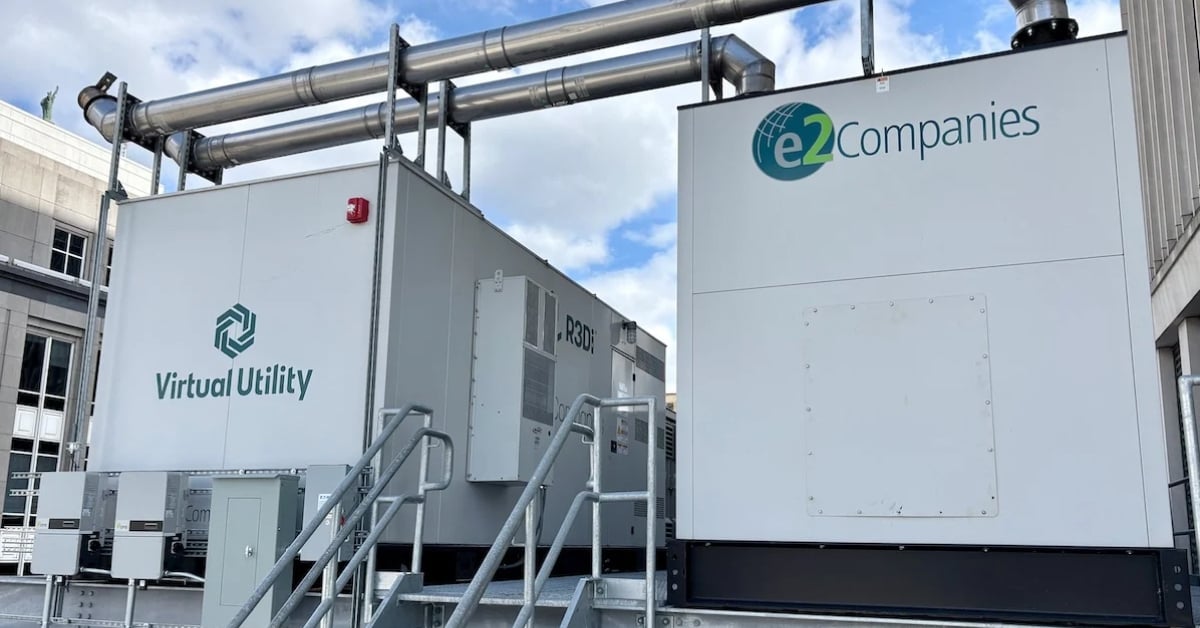 Partner Spotlight: How 34 Group Is Building Community and Resiliency In Western New York
 See how on-site power can improve your facility’s reliability, control, and performance.
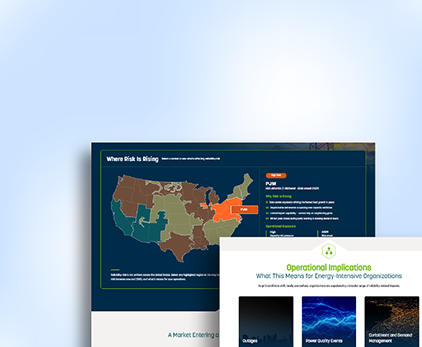 Get a clearer view of regional grid risk, operational exposure, and the path forward.